
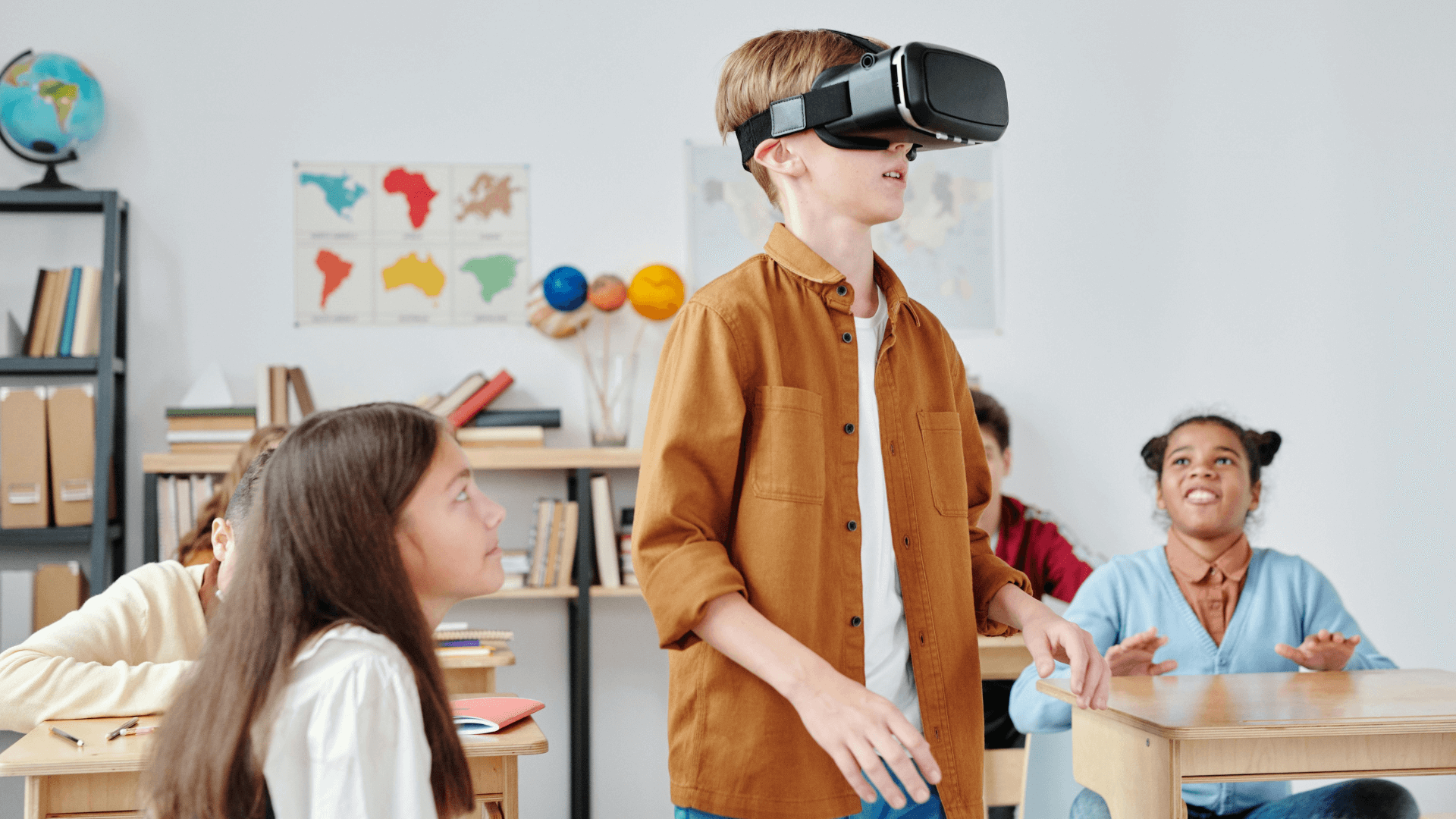
Developments in technology continue to define the ways in which we teach and learn. Innovations such as Virtual Reality (VR), through interactive 3D environments, have offered a more immersive way of learning.
The opportunities are limitless, from conducting virtual field trips to science experiment simulations, and education can be taken one step further.
However, the true potential of VR for education can only be realised if it has the right infrastructure. In this case, it needs robust broadband connectivity with ultra-fast speeds.
Broadband connectivity is the foundation to allow these immersive learning experiences to take place. Without it, VR learning experiences will be very limited.
How Is Virtual Reality Used In An Educational Setting?
In a nutshell, VR is the use of simulations that are computer-generated. These simulations allow students to engage in 3D environments in real-time from wherever they are. These experiences will either be partially immersive if they use computers or mobile devices, but fully immersive by using VR headsets.
VR has become a powerful tool for education by improving engagement between learners and offering an experimental form of learning, which is usually more successful when it comes to retention.
Moreover, it caters to students who are visual and kinasthetic learners which can improve their overall learning experience.
VR is particularly significant in language learning where students can interact with virtual speakers as well as virtual science labs.
The Role Of Broadband Connectivity
Broadband connectivity refers to Internet access that is always available and much faster than previously used dial-up versions. This access can be delivered through fibre-optic, satellites, 5G or wireless cables.
These connections are known to be more secure and reliable, offering high speeds with low latency and minimal lag times, reducing the risk of disruptions.
VR applications rely heavily on broadband connectivity as they work by transferring vast amounts of data. This process needs to be done as quickly as possibly and reliably, which broadband can offer.
How Does Broadband Support VR In Education?
In an educational setting, broadband connectivity supports VR in a number of ways. From streaming to multi-user experiences, let’s take a look at how broadband enables VR to work.
Cloud-Based VR Applications
The majority of VR applications are cloud-hosted which means that the experiences are processed and created on remote servers.
With broadband, students can access the most updated VR content and regular software updates will fix any security gaps.
Without an Internet connection that is fast and stable, these cloud-based platforms can’t be used or will have significant lags, disrupting learning time.
Content Is Streamed In Real-Time
VR content is incredibly data heavy and when multiple students stream content in real-time, there is major demand on the broadband’s bandwidth.
A high bandwidth will make sure that all textures and 3D models are rendered in high-resolution to maintain immersion.
Symmetrical upload and download speeds will also play an important role in allowing two-way interaction when VR experiences are collaborative.
Multi-User Experiences
Educational VR often requires multiple students to work together or navigate virtual spaces. A robust broadband connection will allow learning sessions to be synchronous where students can interact with teachers and each other in real-time.
Here, voice and text will need stable upload and download speeds to support these interactions.
Manages Network Traffic
When hundreds of students need to access online platforms at the same time, networks can become overloaded if they don’t have sufficient bandwidth.
Broadband with high-capacity supports the use of multiple VR headsets operating simultaneously without any lagging. Moreover, teachers are able to keep track of student progress in real-time through platform dashboards.
Supports Special Education
VR offers customised learning environments for students with special needs. Broadband enables teachers to adjust their content based on how students are reacting in real-time to provide personalised experiences.
Additionally, these students can receive remote support from specialists or therapists to help them with their learning difficulties.
Can Broadband And VR Bridge The Digital Divide?
Broadband and VR can significantly contribute to bridging the digital divide by serving those in outlying or rural areas.
Broadband supports remote learning with this immersive content in these areas, which students may have otherwise not had access to.
However, connectivity barriers still exist as most broadband infrastructure is not available in rural regions. This is an ongoing issue and would require government and private company partnerships to bring broadband to these areas.
What Is The Future Of Broadband And VR In Education?
The rollout of 5G networks will see even faster speeds and incredibly low latency as well as more device capacity in virtual classrooms. As a result, VR capabilities will become even more advanced with elements like AI-integrated tutors and holographic learning.
Innovations in edge computing will also bring the processing of data much closer to users, further reducing latency. This, together with broadband, will create personalised learning experiences in real-time and more security over data, particularly for younger users.
It will certainly be exciting to see how the educational landscape will continue to develop with the advancement of these technologies.




 is changing the educational landscape through immersive experiences. Here is broadband's role in supporting them.)